
Date04.06.26
Location Africa
News
Fika 2026 (formerly known as Bridges to Prosperity)
We are very proud and happy to share that this this week, volunteers from Dar will join colleagues from sister Sidara companies, TYLin and Introba, in Rwanda for the 2026 Fika build, continuing a partnership that has helped deliver safe and reliable crossings for rural communities across the country.
From June 6th until the 21st, the team will support the construction of the Kira Trail Bridge, a 75-metre suspension bridge in Rwanda’s Gasabo District, near Kigali. Once the bridge is complete, it will provide year-round access across the Rumirabahashyi River for more than 11,000 residents living in the communities of Kira, Gitaraga, Gishure, Rugazi, and Nezerwa.
Connecting communities across Kigali’s Rumirabahashyi River
Within Rwanda’s Gasabo District, the Rumirabahashyi River has long shaped the movement and daily routines of surrounding communities. Like many rivers across Rwanda, it forms part of the area’s wider geography and landscape, supporting nearby communities, agriculture, and local activity throughout the year.
During the rainy seasons, however, rising water levels can quickly transform the river into a difficult and sometimes dangerous crossing for residents travelling between neighbouring communities. Journeys that may otherwise take minutes can become unsafe or inaccessible altogether, affecting access to schools, healthcare services, markets, and places of work.
For families living near the future bridge site, these disruptions are part of everyday life during periods of heavy rainfall. Children may be unable to attend schools located on the opposite side of the river, while access to healthcare and economic activity can also become limited until water levels recede.
The Kira Trail Bridge is intended to help address these challenges by providing a safe, reliable, year-round crossing for surrounding communities, improving access to the services, opportunities, and connections that support everyday life.
The project also builds on previous successful bridge initiatives completed through the partnership in Rwanda. In 2024, volunteers from Dar, TYLin, and Introba contributed to the construction of the Muregeya Hybrid Bridge, supporting safer access for more than 2,500 residents. In 2025, the partnership returned to Rwanda to support the delivery of the Kajeje Trail Bridge, a 45-metre suspension bridge serving more than 4,000 people across the communities of Kajeje, Mbirizi, Mataba, and Cyanika.
These initiatives represent more than a continued commitment to improving rural connectivity. They also reflect Sidara’s wider vision of creating places where humanity and nature can coexist — delivering infrastructure that responds to local challenges while strengthening communities, supporting resilience, and expanding opportunity in a way that remains connected to the environments it serves.
From Bridges to Prosperity (B2P) to Fika
This year’s build is also the first bridge initiative under Fika, the new name of the organisation formerly known as Bridges to Prosperity.
The name Fika, derived from Kiswahili, Zulu, and several other African languages, means “to arrive”, carrying the deeper meaning of arriving safely. The new identity reflects the organisation’s evolution from a bridge-focused non-profit into a broader access partner supporting rural mobility and connectivity at scale.
Fika works with communities and governments to deliver safe, reliable access at scale, helping people reach schools, healthcare services, markets, and places of work every day. Through community-built trail bridges, government partnerships, and digital planning tools, the organisation aims to improve access to connect people to opportunity.
That idea of safe arrival gives added meaning to the work behind each bridge. Beyond the structure itself, projects such as Kira help communities remain connected even during periods when seasonal conditions make travel difficult and challenging.
This year’s guiding message — “Safe arrivals for everyone, everywhere” — reflects both Fika’s mission and the shared responsibility carried by everyone involved in the build.
The 2026 Sidara volunteer team
The Kira build will be delivered through close collaboration between Fika, local community members, and volunteers from Dar, TYLin, and Introba. The volunteer team will also be supported on the ground by Dar Rwanda, established in 2021, which has contributed to several strategic projects across the country.
This year’s team brings forth expertise across construction, safety, logistics, quality control, materials coordination, communications, team building, and community engagement.
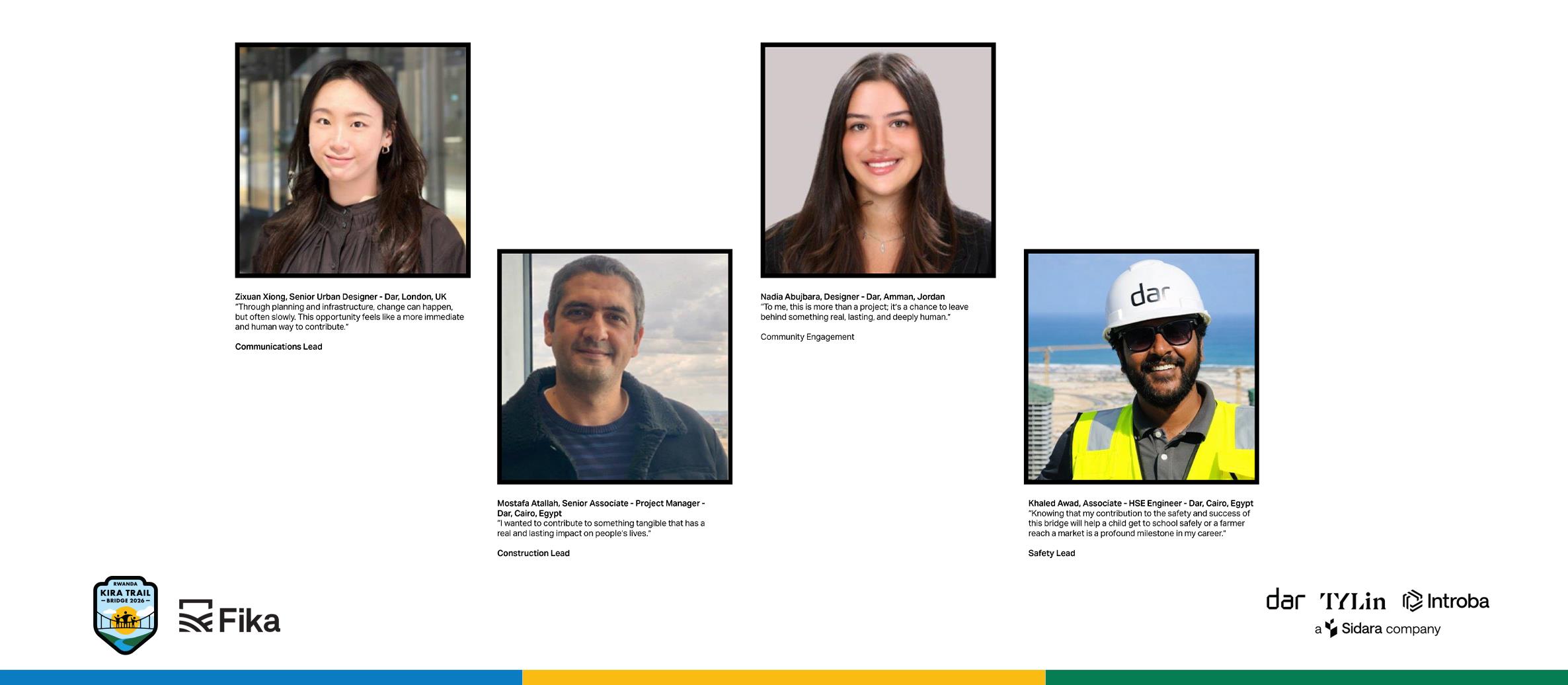
Representing Dar are:
- Nadia Abujbara as Community Engagement Lead from Dar Amman, Jordan
- Khaled Awad as Safety Lead from Dar Cairo, Egypt
- Mostafa Atallah as Construction Lead from Dar Cairo, Egypt
- Zixuan Xiong as Communications Lead from Dar London, United Kingdom
They will be joined by:
- Steven Skeele as Project Lead from TYLin Houston, USA
- Lucia Cuesta Moreno as Logistics Lead from TYLin, Barcelona, Spain
- Fady Bou-Shebel as Construction Lead from TYLin, San Francisco, USA
- Diego Serrano Suarez as Safety Lead from TYLin, Bellevue, USA
- Su Wan-Ting as Quality Control Lead from TYLin, Taipei, Taiwan
- Francesca Bochicchio as Materials Lead from TYLin, Madrid, Spain
- Nura Darabi as Team Building Lead from Introba, Sherman Oaks, USA
Looking ahead
Throughout the two-week build, volunteers will work closely alongside Fika teams, local partners, and surrounding communities to support the delivery of the Kira Trail Bridge, contributing technical expertise while engaging directly with the people and communities the project is intended to serve.
As the 2026 team prepares to begin the Kira build, the initiative represents another step in a partnership shaped by technical expertise, volunteerism, and shared purpose. What began as a bridge-building initiative has evolved into a wider effort focused on improving safe access, strengthening resilience, and helping communities remain connected to opportunity throughout the year.
And in many ways, the meaning behind Fika captures that journey clearly: to arrive safely, remain connected, and help create greater opportunity for the communities it serves.