
Date29.06.26
Location Africa
Conference
As Angola continues to invest in energy and water infrastructure, increasing attention is being given to maximising the value of existing assets through smarter and more efficient operations.
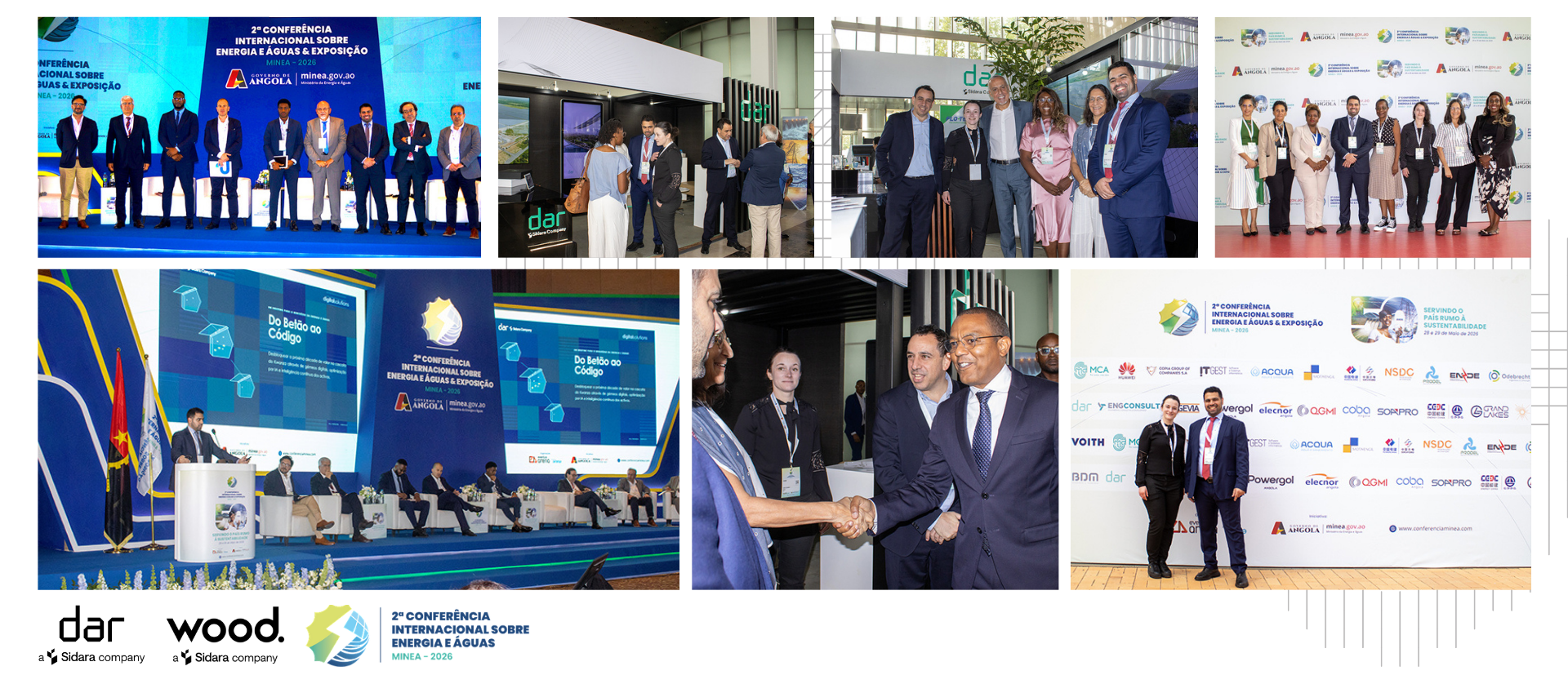
At the 2ª Conferência Internacional de Energia e Águas in Luanda, Dar participated as an event sponsor, exhibitor, and contributor to the technical programme alongside sister Sidara company, Wood. The conference brought together government leaders, investors, industry experts, academics, and business representatives to discuss the sector’s key challenges and opportunities, with a focus on technological innovation, sustainability, and strategic collaboration.
Representing Dar on the “Technological Innovation and Digitalisation” panel, Lead Digital Strategy Consultant Amr Yafi delivered a presentation titled “Digital Twins for Angola’s Energy and Water Infrastructure.” The presentation focused on the Kwanza hydroelectric cascade, where dams operate in series, and upstream releases directly influence downstream storage, power generation, ecological flows, and water availability.
Building on digital twin work conducted in 2025 by a task force from Dar and SuYapı, the presentation explored how digital twins can serve as operational tools that support decision-making rather than acting solely as visualisation models. The discussion examined how live asset data, hydrological models, analytics, artificial intelligence, and control room workflows can strengthen reservoir planning, cascade coordination, predictive maintenance, and structural health monitoring.
Dr. Diana Jeleňová from Wood also presented on “Green Hydrogen: Production, Grid Integration, Storage, Transport, Conversion and Use,” highlighting hydrogen’s potential to support renewable energy integration, improve off-grid resilience, and contribute to future export opportunities.
Dar’s participation builds on our long-standing involvement in Angola’s energy sector, including our work on the Cambambe hydropower plant on the Kwanza River and consultancy services for the public renewable energy programme, which encompasses seven photovoltaic plants, one million solar panels, and more than 370 MW of clean energy serving more than one million people.
The central message emerging from the conference was clear: the future performance of critical infrastructure will depend not only on new investments but also on how existing assets are operated, coordinated, and maintained over time.