
Date24.11.26
Location Europe
Event
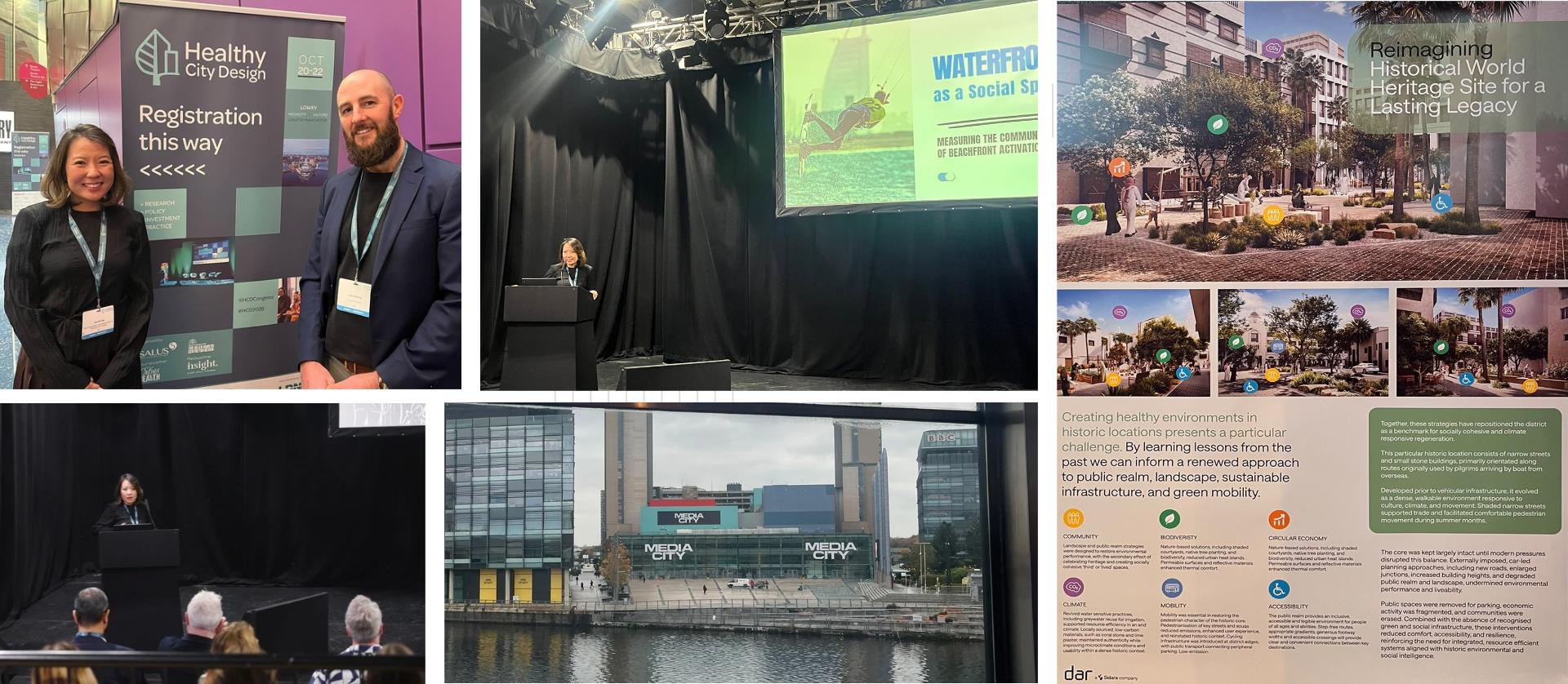
At the 10th Healthy City Design International Congress in Salford, Dar shared perspectives on how people-centred design can create healthier, more resilient and socially connected places, from a World Heritage Site to one of Dubai’s busiest beaches.
On 20–21 October 2026, designers, planners, public health experts and policymakers from around the world gathered at The Lowry in MediaCity, Salford, for the 10th Healthy City Design International Congress. The congress was held during Salford’s centenary year under the theme “Breakdown or Breakthrough?” It explored how health can sit at the centre of the way cities are planned and built.
Across the two-day programme, Dar contributed on several fronts, from presenting a case study on heritage-led regeneration to joining a lively panel on the future of urban waterfronts.
Dar was also pleased to join its sister Sidara companies, Perkins&Will and Portland whose initiative, The Futures We Build, examines how the built environment can foster human connection, strengthen communities and create long-term resilience.
Heritage-led regeneration
Over the course of the event, Dar presented its case study by Daniel Reynolds, Principal Landscape Architect - Design & Concept Development at Dar, Reimagining a Historic World Heritage Site for a Lasting Legacy. It explores how public realm design, sustainable infrastructure and green mobility can work hand in hand to support climate-responsive regeneration while strengthening social cohesion.
Designing urban waterfronts for wellbeing and connection
From historic streets, the conversation moved to the water’s edge. Dar contributed to the panel discussion Designing Health in Urban Waterfronts, chaired by Max Farrell of The LDN Collective. Senior Economic Development Consultant - Project Strategy & Feasibility Advisory at Dar, joined Luke Heslop of Brunel University on the panel, alongside representatives from the University of Liverpool, Makower Architects and Be First. The panel explored how waterfronts can be designed to support healthier, more connected communities.
Joanne and Luke drew on Dar’s work on Umm Suqeim Beach in Dubai. They highlighted the role of waterfronts as a “social spine” that promotes wellbeing, social interaction and community cohesion.
An iconic beach for a growing city
Spanning 11 km within sight of the Burj Al Arab, Umm Suqeim is Dubai’s longest beach and one of its best-known destinations. Dar reimagined it through an integrated socio-spatial and anthropological approach, studying the beach’s spaces and the people who use them together. The approach balances the beach’s iconic character with the needs of a population that has grown by 430% since 2000.
The design organises the coastline into three distinct zones: Tranquil, Day and Night. Each offers its own opportunities for recreation, from calm retreats to evenings by the sea. Together, they keep the beach active all year round and enhance its value as a vital public asset.
Designing places where people thrive
From the timeless streets of a World Heritage Site to the sun-drenched shores of Dubai’s longest beach, Dar illustrated that people-first design is how places truly come alive, nurturing healthier, more inclusive and more connected communities. Wherever we work, our focus remains on outcomes that uplift the communities we serve.
We extend our sincere gratitude to the organisers, fellow speakers and attendees for two days of insightful discussion on the future of healthy, inclusive and sustainable cities.